الفكرة الافتتاحية
In many Palestinian homes, a father's day begins before his children wake; the person who pays for the household may also be the person least present in the details of its daily life.
In many Palestinian homes, a father’s day begins before his children wake.
He leaves while the village is still asleep, travels along a road and through a checkpoint or gathering point, waits for a permit, a bus, or a contractor, works long hours, and returns in the evening after spending most of his energy somewhere else.
He may be the person who pays for the home, the installments, university, the car, and food. At the same time, he may be the member of the family least present in the details of its daily life.
This is not the story of every Palestinian worker, nor of every family. Yet the scene has repeated itself over decades, making it difficult to see Palestinian labor in the Israeli market as a matter of wages, permits, and checkpoints alone.
Work does not simply move the body from one place to another.
Sometimes, it rearranges the home to which the worker returns at the end of the day.
More than an economic relationship
The usual explanation for Palestinian labor in Israel is simple and convincing: the wage gap.
The worker goes because the income is higher, because the Palestinian economy does not offer enough opportunities, and because the family needs the money.
All of this is true.
But perhaps the matter runs deeper.
When an economic relationship of this scale continues for many years, it does more than affect calculations of income. Gradually, it begins to redefine success, masculinity, education, social standing, and even the shape of the relationship between a father and his children.
What began as an economic solution becomes a social force.
The paradox is not only that a Palestinian works within the economy of the power occupying his land. It is also that, for tens of thousands of families, this economy has become one of the most important available routes to building the Palestinian home itself.
The occupation does not always remain outside the home.
Sometimes, it enters in the form of a wage.
The man whose worth is proven by what he can pay
In societies with weak safety nets and public institutions, the family bears a large share of the responsibility for survival.
A father is expected to build the home, finance education, help his children marry, and absorb the costs of illness, emergencies, and debt.
In such an environment, the ability to spend becomes more than a financial capacity. It becomes a measure of personal success.
A man is asked not only whether he is a good father, but whether he is capable of “opening a home” and establishing a household.
His stability is measured not only by his relationship with his family, but by his ability to provide for them.
Here, masculinity itself begins to acquire an economic definition:
The capable man is the man who can pay.
When a worker entering the Israeli market can earn more than an employee, teacher, or university graduate, society does not need to announce officially that its values have changed.
Young people need only observe who managed to build first, who bought a car, who married, who expanded his home, and who gained greater spending power.
Values are not transmitted through advice alone.
They are transmitted through the people whom life appears to have rewarded.
The father who is financially present and absent in time
There is a form of absence that does not resemble abandonment.
The father is there. He loves his children. He works for them. He returns to them every evening or every few days. No one can accuse him of abandoning his family.
Even so, large parts of their lives may pass without him.
Sometimes he does not know the small details of school, the disagreements between his children, the psychological changes they are experiencing, or the people who have become close to them.
Not because he does not care.
But because work takes the time he needs in order to be more than the family’s provider.
And when he returns, he may return in an exhausted body that wants only food, rest, and sleep before another day begins.
An unspoken division can then emerge inside the home:
The father is responsible for the economy.
The mother is responsible for life.
She is the one who knows about school, appointments, problems, illness, clothing, relatives, moods, homework, and the small needs that never appear on a bank statement.
The father’s presence, meanwhile, appears through the things he has been able to provide.
The problem here is neither the man nor the woman.
The problem lies in a structure that makes one of them pay the family’s price through his body and time, while leaving the other to carry much of the invisible daily burden alone.
When love becomes something that can be bought
In a family with little shared time, money can sometimes compensate for part of the absence.
A new phone, clothes, spending money, a trip, a gift.
Not because these are real substitutes for a relationship, but because they are among the few tools an exhausted father has to say:
I am thinking of you.
That expression may be entirely sincere.
The danger begins when the family unintentionally learns to translate love into the ability to provide.
As a child grows up within this model, he too may begin to understand fatherhood and success through the same measure.
The successful father is the one who “never left us wanting.”
On its surface, the phrase is beautiful.
But the question is: what does it mean to fall short?
Does it mean that the child should not go hungry?
That the child should want for nothing?
That the child’s standard of living should not fall below that of others?
Or does it also mean that the child should know his father, sit with him, hear him, and encounter a man who carries not only the responsibility to spend, but also room for conversation, vulnerability, play, and time?
Societies do not lose relationships when people stop loving one another.
They may lose them when people no longer have enough time to practice that love.
The lesson a child learns without being told
The Palestinian family asks its children to study.
It may spend a large part of its income on their education.
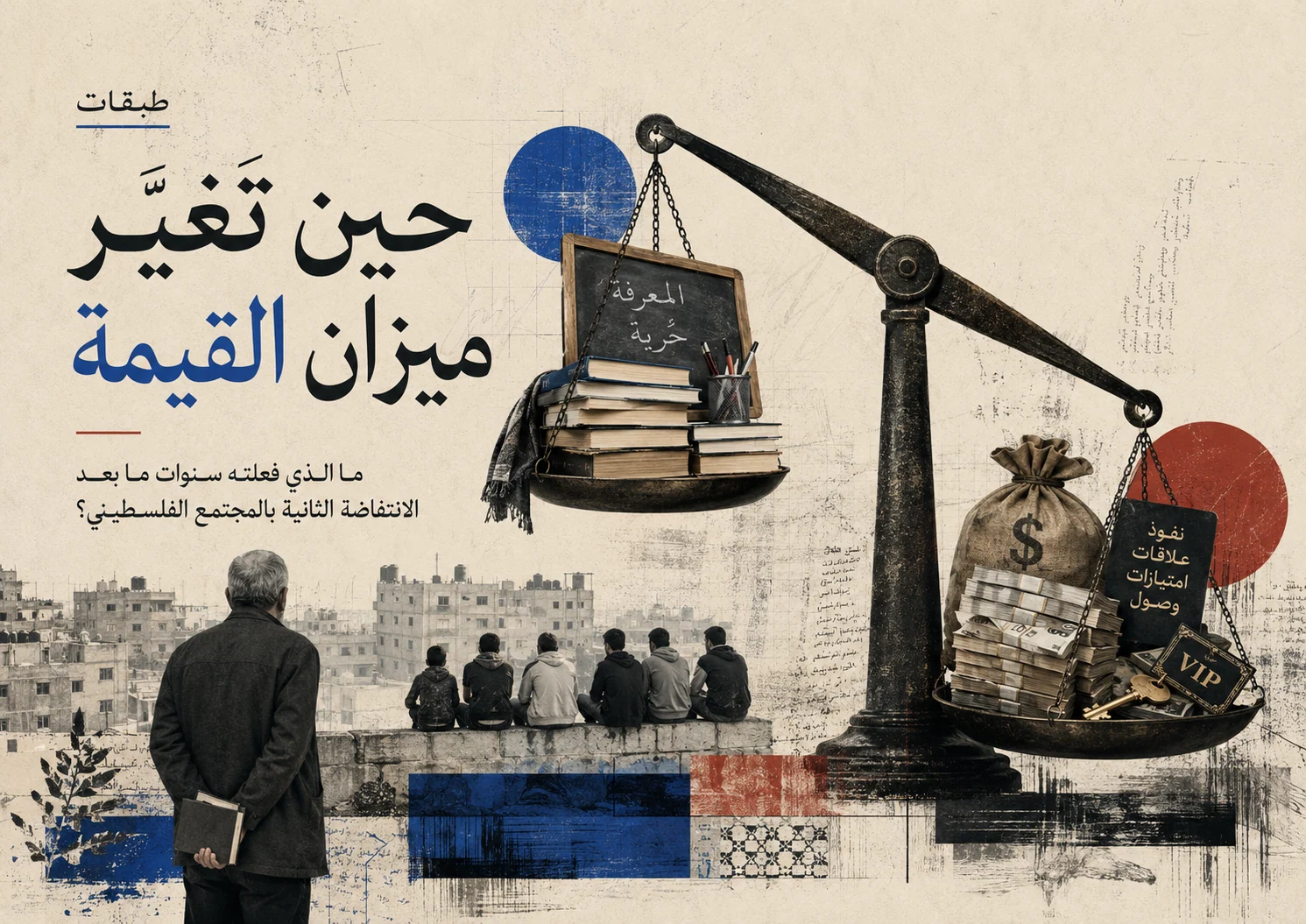
But a child who grows up surrounded by a clear contradiction between education and income grasps the message quickly.
The child sees a teacher who studied for years and still struggles to meet basic needs.
He sees a university graduate searching for work.
Then he sees a relative or neighbor who left university—or never entered it—working in construction or industry inside Israel and becoming more able to establish a life.
No one needs to tell the child that education has no value.
Reality can say that on its own.
The worker is not the problem here, nor is the graduate morally or humanly superior to him.
The problem is that the economy gives the next generation a different lesson from the one given by the school.
The school says:
Learn, and you will advance.
Reality sometimes says:
Find the place that pays more.
When the contradiction between these messages endures, education begins to lose part of its social argument.
Not because people have stopped respecting knowledge, but because knowledge is no longer always able to grant its bearer the independence it promised.
An entire economy behind the checkpoint
There is a harsher paradox.
When a worker builds a home with a wage earned in the Israeli market, he is unquestionably building a better life for himself and his family.
But society as a whole is not necessarily building a more independent economy.
The money enters the village, but it was not produced there.
The opportunity that raised the family’s income did not emerge within its own economy.
Thousands of individuals may therefore improve their economic circumstances while the structure in which they live remains weak.
This is one of the most complex forms of dependency because it does not always look like a constraint.
It may appear as an opportunity.
The worker comes to depend on the market that pays his wage; the family depends on that wage; shops depend on the family’s purchasing power; banks depend on installments; and the property market depends on liquidity.
An individual employment relationship begins to produce a broad network of reliance.
With every closure, ban, or withdrawal of permits, what ordinary days concealed suddenly becomes visible:
The economies of entire families may be tied to a decision those families do not control.
The stability that appears personal may be more political than we imagine.
A bigger house is not always a better life
Labor inside Israel has undoubtedly helped many families escape poverty, build homes, educate their children, and improve their standard of living.
To deny this would be unjust to people and their experiences.
Yet one transformation worth considering is the relationship between increased spending power and the expansion of what we believe we need in order to consider ourselves successful.
The home becomes bigger.
The car becomes newer.
The cost of marriage rises.
Things once considered luxuries become almost mandatory social requirements.
At that point, a higher wage is no longer only a way out of pressure.
It can become a reason for the pressure itself to increase.
Every increase in spending power can produce a new level of expectation.
A family that could live on less yesterday may find itself unable to return to that level today without feeling that it has fallen in social standing.
And so the worker works more to maintain a standard of living that now depends on that same work in order to continue.
This is not uniquely Palestinian, of course.
But it becomes harsher when the source of income is tied to a checkpoint, a permit, and political stability.
Do not make the worker guilty
It would be very easy for this discussion to become a moral indictment of workers.
That would be the laziest possible conclusion.
The worker did not create the wage gap.
He did not create the weakness of the Palestinian economy.
He did not decide that a local wage would be unable to compete with what he might earn only a few kilometers away.
He did not invent the system of permits, checkpoints, or dependency.
When a person must choose between fine words about the national economy and the actual ability to feed his family, asking him alone to pay the price of principle is not collective heroism.
It is the transfer of responsibility from the system to the individual.
The real question is not:
Why does the Palestinian worker go to work in Israel?
In most cases, the answer is known.
The harder question is:
Why have the Palestinian economy, society, and institutions been unable to offer another path—one that grants him an income, dignity, and stability close to what he seeks there?
The occupation that reshapes the person from within
We are accustomed to thinking about occupation through land, checkpoints, soldiers, settlements, and imprisonment.
All of these are direct and visible instruments of control.
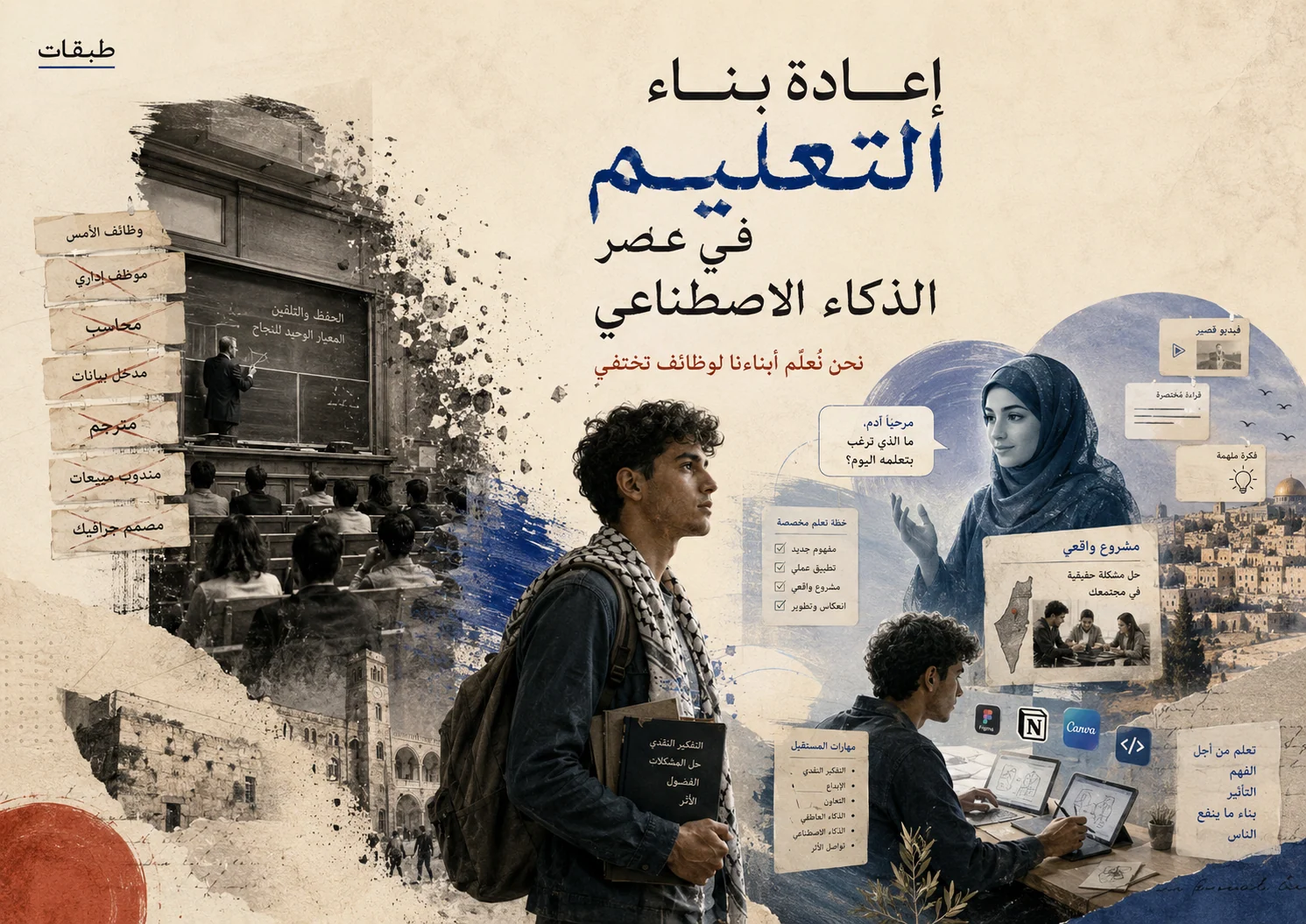
But there is a less visible form of power: the power of an economy to determine what people believe is worth learning, where they work, how they build their homes, and what they consider success.
When the highest available income for a broad part of the working class exists inside the economy of the power that controls them, the relationship is no longer merely one between a worker and an employer.
It begins to re-engineer aspiration itself.
A young man chooses his trade according to the Israeli market.
A family arranges its life around a permit.
A bank builds its calculations around the wage.
Society measures success by what the worker has been able to buy.
A child grows up seeing that the fastest route to stability passes, sometimes quite literally, through the checkpoint.
This is a power deeper than the ability to close a road.
It is the ability to determine which road people want opened.
What did we pay in exchange for the wage?
The point is not to imagine a romantic time when Palestinians did not need money, to ask people to abandon their livelihoods, or to turn the worker into a new political symbol.
The point is simply to see the full cost.
There is a wage the worker receives.
But there is also time consumed, a body exhausted, a family redistributing its roles, children learning a particular definition of success, a local economy losing part of its ability to compete, and a society gradually learning that income can grant a person a status that knowledge does not always confer.
Not all of these outcomes are inevitable.
Not all families are alike.
But we are mistaken when we measure the impact of labor only by the money that entered, as if the economy could pass through society without leaving anything behind in people’s inner lives, relationships, and values.
Perhaps the question worth asking after decades of Palestinian labor in the Israeli market is not how much the worker earned, nor even how much he lost.
It is:
What kind of society has this relationship produced?
A society in which a father can build a house, yet lose some of the time that would have made it a home.
A society that still tells its children that knowledge is the road to the future, while some of them watch men cross the checkpoint every morning because reality has told them that the road to stability lies somewhere else.
Labor inside Israel has not consumed workers’ bodies alone.
It has slowly entered our definitions of work, masculinity, family, and success.
When absence becomes part of the wage, we must ask not only how much does the work pay?
But also:
What do we pay in return?

احمل السؤال إلى الأمام
What kind of society has this relationship produced?
صُمّم النقاش أدناه لاستقبال ردود متأنية. سمِّ الدليل أو الخبرة المعيشة التي تعتمد عليها إجابتك.