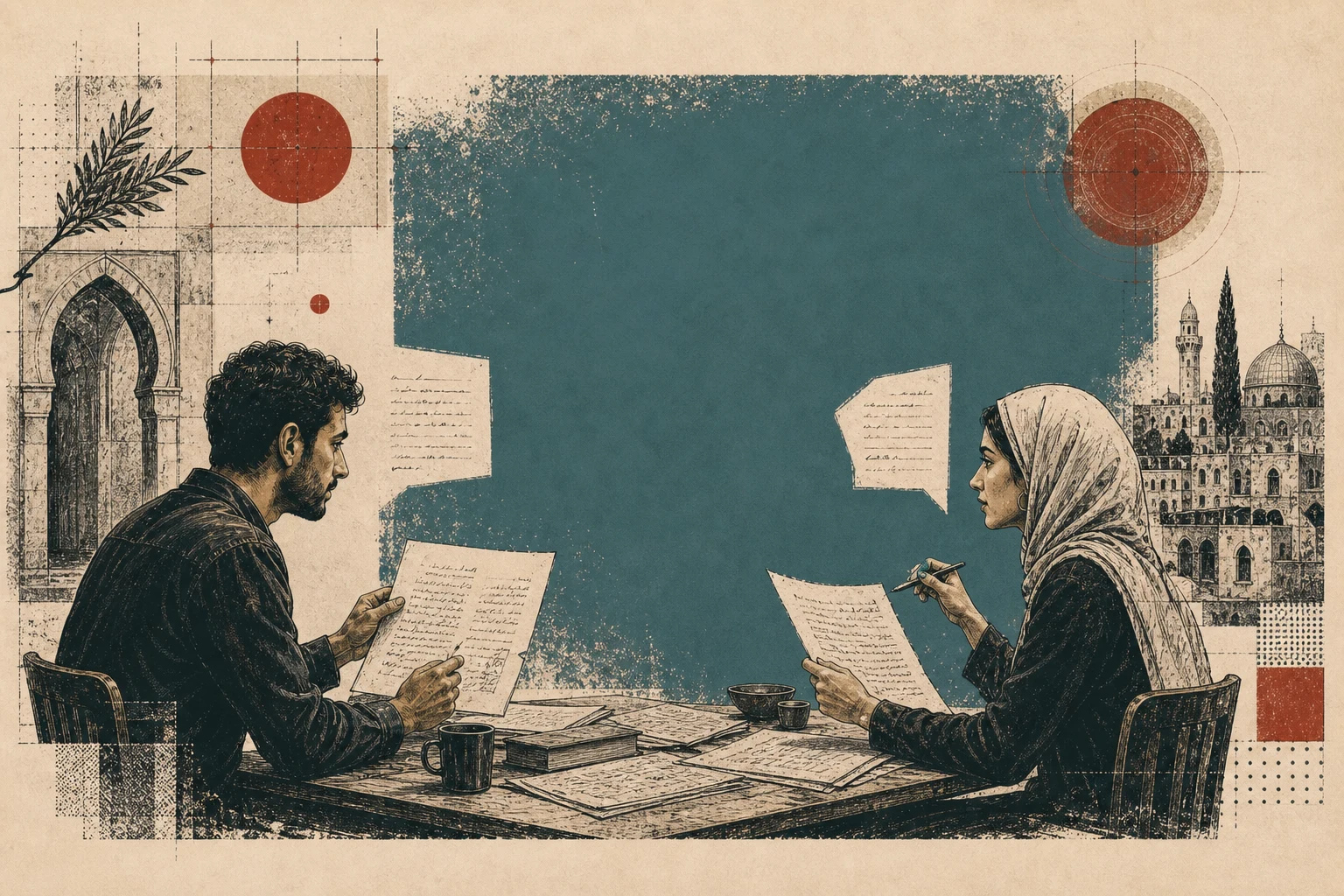
الفكرة الافتتاحية
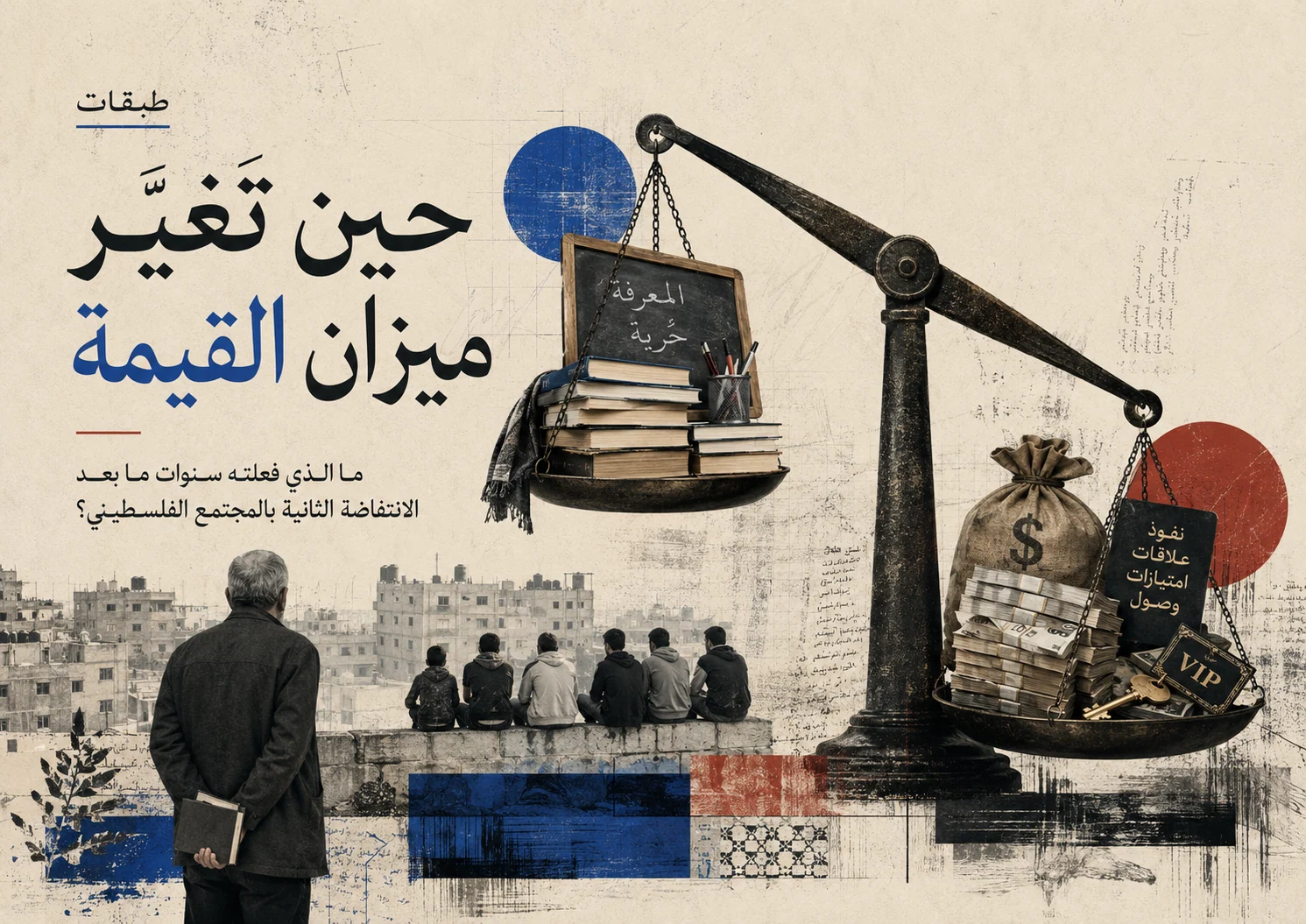
Since the Second Intifada, Palestinian life has not been the only thing to change. Less visibly, and more dangerously, the society's system of value changed too.
When Palestinians are asked what the Second Intifada did to their society, the well-known answers quickly come up: murder, arrests, invasions, checkpoints, the destruction of the economy, the dismemberment of geography, and then the political division that came later to turn the fissures into semi-permanent borders.
All of this is true, but it alone does not explain what happened.
Major transformations do not only leave their effects on buildings, the economy, and political institutions. It is slowly entering the way people see themselves, the standards of respect and success, and the image of a person who deserves to be heard, to sit at the forefront of the council, and to be presented to the people of society as a model to approach.
What is meant by the value system here is not the values that society declares about itself, but rather those revealed by its actual behavior: who is respected? Who is afraid? Who is imitating? Who will marry his children to? Who requests his mediation? Who believes his story about the world?
Society may continue to glorify science in its speeches, celebrate morality on occasions, and praise sacrifice and equality, but it reveals its true values in the details of daily life, not in the words it says about itself.
In these details, a profound revolution occurred.
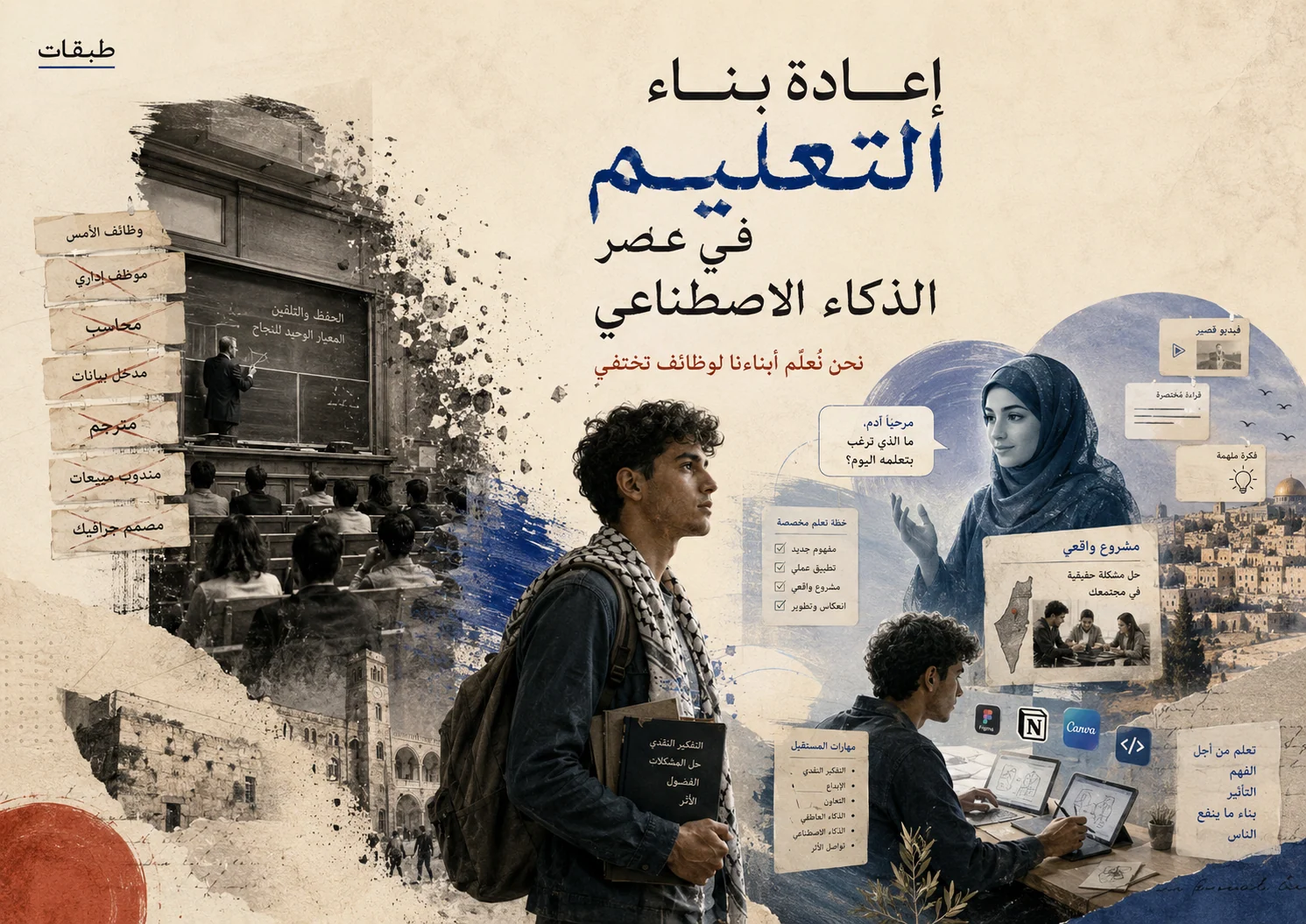
When education stopped fulfilling its promise
Education has historically occupied a special place in the Palestinian experience.
It was not just a path to a job, but rather one of the few tools by which a Palestinian could overcome poverty, poor family status, or narrow geography. The family, which did not have large land, trade, or influence, could rely on the education of its children and see martyrdom as a form of advancement and liberation.
The teacher, doctor, lawyer, writer, and university professor all had status not necessarily based on wealth. One of them may not have been the richest man in town, but he had what was most important within a society that valued knowledge: a voice, confidence, the ability to influence, and a moral position that did not require a luxury car or a large bank account to prove his presence.
This is the contract that existed between knowledge and status:
Learn, work hard, and educate yourself, and your value within society will increase.
But this contract began to collapse.
The number of graduates has swelled, job opportunities have declined, and the value of salaries has decreased. For many, the university has transformed from a space for the formation of the mind into a long station that only guarantees its owner a social title and a deferred promise of stability.
Knowledge no longer necessarily produces independence, and a degree no longer gives its holder the ability to build a decent life. In contrast, other, more direct paths to money and status appeared before society.
The young man began to believe that someone who left education early and went to work might be more capable of building a house and starting a family than someone with a degree. He believes that the person concerned can enter an institution that does not open its doors to the most qualified. He believes that the merchant who is able to move money and goods has an influence greater than that of the professor, writer, and researcher.
This does not mean that society has stopped respecting language education. Families still celebrate graduation, hang pictures of their children, and brag about their university titles.
But at the same time she acts as if she knows another truth:
A certificate gives you a name, but money gives you weight.
And here education begins to lose its argument in front of the new generation.
The child does not learn values from what adults say only, but from the way they behave. He notices who is warmly received, whose opinion is sought, who people seek to befriend, whose problems are solved quickly, and who can raise his voice without being interrupted.
It may not take him long to understand that the society that requires him to learn does not necessarily reward the learner.
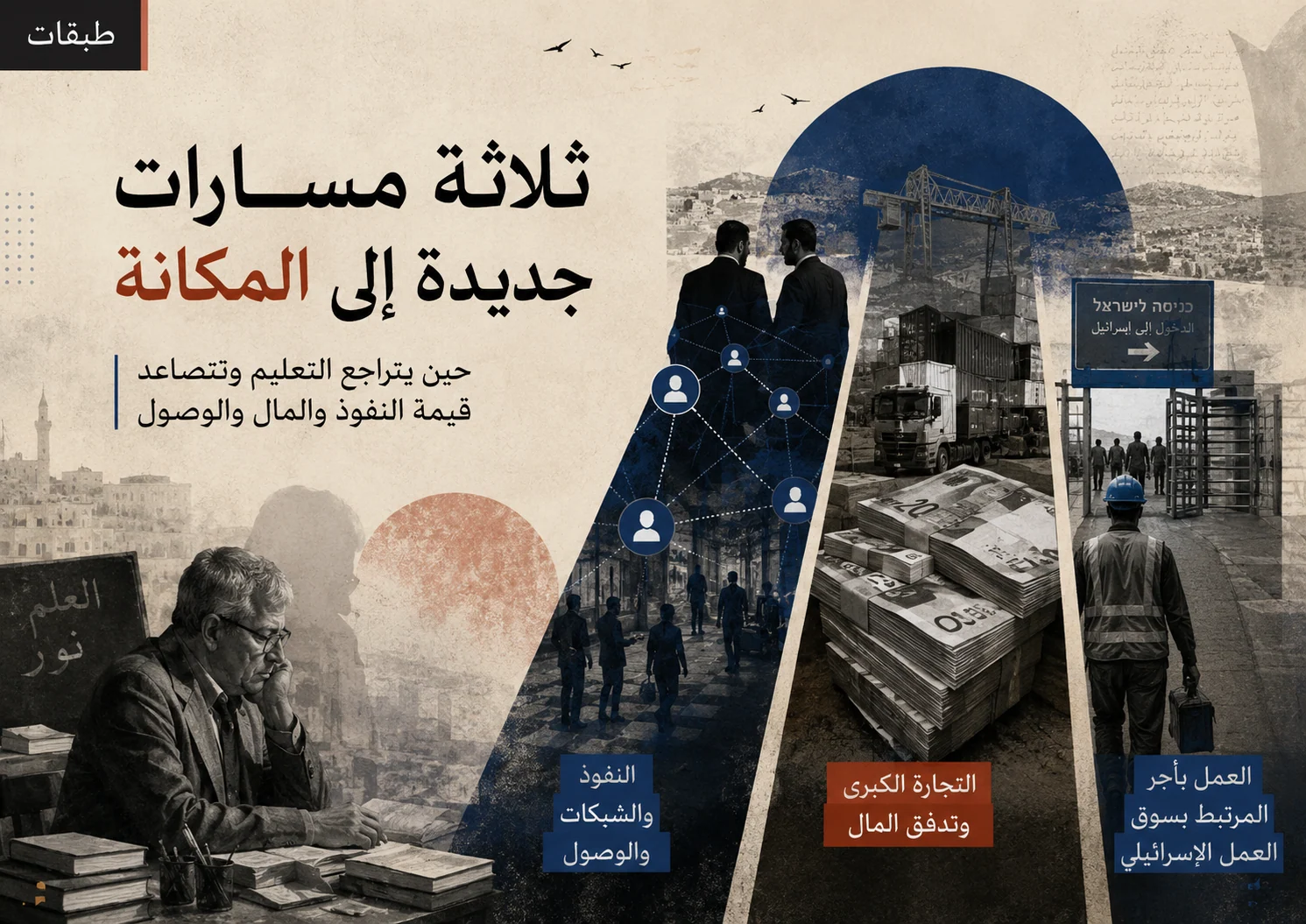
Three new paths to status
In the Palestinian society that was formed after the second intifada, three categories emerged remarkably in producing the new social status: the powerful, the big merchant, and the worker in the Israeli market.
These categories are not identical, nor are they morally or economically equal, but they represent three paths to power that do not necessarily pass through knowledge and culture.
The powerful has access.
His strength lies not in what he knows, but in who he knows. He can facilitate a function, or hinder it, open an administrative or security door, mediate with the institution, and grant or withdraw protection. In a society where public rules are weak, access to the person becomes more important than access to the law.
The big trader owns the movement of money, commodities and contracts.
In a restricted economy dependent on imports, distribution, permits and relationships, power does not always come from production or innovation, but from control of the gate through which resources pass.
Then comes the Palestinian worker, who should not be viewed as privileged, as he often lives under a harsh system of barriers, permits, humiliation, and instability. But, in terms of monetary income, he may find himself more capable than a teacher, employee, or university graduate to build a house and support a family.
The problem is not that these categories do not deserve recognition. The worker gets tired and takes risks, the merchant may create real opportunities, and any society needs management, economics, and work.
The problem is that society has failed to maintain a parallel path that gives knowledge, culture, and public contribution real material power and status.
The worker did not rise above the intellectual as much as the intellectual fell below everyone else.
The merchant has not only become more influential because he has money, but also because cultural and educational institutions have lost their ability to transform knowledge into legitimate influence.
From intelligence to “management of the situation”
When the reward system changes, the meaning of intelligence itself changes.
The smartest person is not necessarily the one with the deepest knowledge, the most analytical ability, or the most productive. The smart one may be the one who knows how to “manage himself,” how to approach the right person, how to get the deal, and how to go beyond the rule without being punished.
Cleverness transforms from the ability to understand into the ability to maneuver.
This transformation is not only linguistic. It reshapes young people’s ambitions, shaping the kind of skills they believe life rewards.
If a society punishes integrity when it gets in the way of interest, ridicules the intellectual who is unable to secure his own income, and respects those who have the ability to bend, then its children will begin to understand opportunism as a form of intelligence, access as a substitute for competence, and wealth as a sign of value.
Corruption in this case becomes not only an individual aberration, but a silent educational model.
When the network replaced the institution
The decline in the value of education was not separate from the decline of the institutions that linked the individual to society.
Unions, student unions, popular committees, cultural frameworks, local initiatives, and volunteer work were all, to varying degrees, spaces in which the individual learned that power could be built collectively.
But the society that emerged from the second intifada was more fragmented, more dependent on salaries, and more tied to vertical institutions.
The individual now needs someone to employ him, an official to protect him, an institution to fund him, a family to support him, or a friend to shorten his path.
The question is no longer asked:
How do we organize ourselves to solve the problem?
Rather, it became:
Who do we know who can solve it for us?
When the institution weakens, society does not remain devoid of power. In their place are family, family, personal relationship, political allegiance, and networks of interests.
Society becomes very cohesive within small circles, but weak on the general level.
Trust in one’s neighbor increases, and trust in the law decreases. The son of the family is protected because he is the son of the family, not because he has a right. Those who do not have a network are left to face the institution alone.
Thus, citizenship turns from an equal relationship into a skill in finding the right mediator.
The rise of religious legitimacy
Alongside money and influence, a third source of status rose: social religiosity.
This should be said with caution, not because the topic is taboo, but because reducing it to phrases like “religion is the cause of backwardness” only produces lazy analysis and gratuitous hostility.
Religious faith was, and still is, a true source of meaning, psychological strength, and solidarity for Palestinians. In a society experiencing loss, fear, and uncertainty, the role that religion plays in helping people endure what is difficult to endure cannot be ignored.
But the problem does not begin when faith increases, but rather when religiosity transforms from a spiritual and moral experience into a social system that grants and withdraws legitimacy.
The aftermath of the second intifada was accompanied by a clear decline in the legitimacy of many political and cultural elites, the weakness of the left, the exposure of the inability of the settlement project, and the rise of Islamic movements as more organized and present in resistance, charitable and social work.
Religious discourse did not triumph because it was necessarily more convincing, but also because other alternatives were losing credibility.
Over time, religious appearance became part of social capital.
It may be assumed that a religious man is more honest, that a conservative family has a better upbringing, that a veiled woman is more respected, and that a religious preacher has higher morals, before actually looking at the behavior.
Here there is confusion between religiosity and morality.
Ethics are measured by fairness, honesty, integrity, respect for the weak, and taking responsibility. As for appearance, it can preserve a moral image for a person even when his actions contradict it.
A merchant may exploit his workers, or a powerful person may take advantage of his position, and then reproduce his legitimacy through donation, charity, and religious discourse. Building a mosque or funding aid may turn into a curtain that prevents society from asking the most difficult question: How was wealth created? Who paid for it?
At this moment, religiosity is no longer only a moral component, but sometimes becomes a means of producing immunity.
When the preacher owns the world’s interpretation
With the decline in the status of the intellectual, the authority to interpret the world shifted not only to the person with money, but also to the person with certainty.
The serious intellectual does not always provide comfortable answers. It asks questions, exposes contradictions, acknowledges complexity, and keeps the door open to possibility and error.
As for the preacher, he can provide a final and coherent answer:
We are defeated because we have turned away from religion. Society became corrupt because morals declined. Victory will come when we become more committed.
This language may have a legitimate spiritual meaning, but it becomes dangerous when it turns into a substitute for political and social analysis.
Then the politician is not asked about his failure, nor the institution about its corruption, nor the organization about its choices. Rather, society is told that its problem lies in the dress of its women, the behavior of its youth, or the weakness of its worship.
The political crisis turns into popular moral guilt.
It becomes easier to ask people to reform themselves than to ask the leadership to justify its decisions.
Women as the boundaries of society
In societies that lose control of the public sphere, the desire to control the private sphere increases.
A man who cannot protect his land from confiscation, prevent intrusions, guarantee his work, or control his future may try to compensate for this deficit within the family.
His sister’s dress, his daughter’s appearance, his wife’s behavior, and the relationships of the women in the family become arenas through which he proves that he still has some power.
Thus, the woman’s body turns into a symbolic border for society.
She is asked to prove that the group has not disintegrated, has not become Westernized, and has not lost its identity. Her public image becomes evidence of the family’s honour, cohesion and belonging.
The problem is not with the hijab or conservatism as personal choices. The problem is when the choice is no longer equally free, and when one form of appearance becomes an implicit condition for respect, while the other form places the woman and her family under surveillance and suspicion.
In this case, the woman is paying the price for a crisis that she did not create alone, and she bears the burden of maintaining the image of an entire society on her body.
A conservative society in the picture, turbulent on the inside
Strict social standards do not always produce more ethical behavior.
May produce greater concealment ability.
When the cost of honesty rises, individuals learn to live double lives: what is said in front of the family, and what is done outside it; Public account and secret account; Public image and private desire.
Sometimes a virtue becomes not to be seen, not not to do wrong.
Society turns into a wide area of mutual control, where people are more concerned with each other’s image than with rights, justice, and integrity.
As the power of reputation increases, the space for honesty shrinks.
A narrower identity
The Palestinian identity, despite its contradictions, was able to bring together the Muslim and the Christian, the religious and the secular, the leftist and the nationalist and the Islamist, and the veiled and non-veiled, within a broader national framework.
But as the national language itself becomes more religious, one model of Palestinians begins to become an implicit standard against which the Palestinianness of others is measured.
Land is defined as religious property before it is homeland, memory, and political right. The martyr, the resistance, and the whole issue are being redefined within a language that not all Palestinians feel represents them to the same extent.
Those who are different are not necessarily expelled, but they find themselves forced to translate their national affiliation into religious language in order for it to become acceptable.
The Christian, the secularist, the artist, the skeptical young man, or the woman who differs from the conservative model turns into a Palestinian who needs to constantly prove his Palestinianness.
When identity narrows, it does not become stronger, but rather less able to bring society together.
From solidarity to charity
Charitable and religious institutions have played a real role in protecting thousands of families, and this role should not be treated lightly.
But there is a difference between solidarity and charity.
Solidarity views the poor as a right holder and a partner in changing reality. As for charity, you may see a needy person receiving help from a capable person.
In the first case, we ask: Why did the system produce this poverty, and how can it be changed?
In the second, we merely mitigate its effects.
Aid prevents hunger, but it does not remove the structure that created it. The poor person has transformed, with time, from a citizen demanding his rights to a beneficiary waiting for the role of the institution, association, or philanthropist.
Poverty is thus managed morally rather than confronted politically.
Four authorities and an intellectual without power
If we want to summarize the status centers that rose after the second intifada, we can say that society began to revolve around four authorities:
- The powerful person has access.
- The merchant has money.
- The worker has cash income.
- The socially religious person has moral legitimacy.
As for the intellectual, teacher, researcher, artist, and community project owner, he may not have any of that.
He does not have the relationship that opens the door, the money that forces attendance, the income that proves success, or the appearance that grants moral immunity.
That is why culture did not decline alone. The human model that the culture represented has declined.
When a person with knowledge loses his position, books do not just disappear. The task of interpreting the world shifts to whoever has the pulpit, the money, or the influence.
The person with wealth becomes able to define success, the powerful person becomes able to define what is possible, and the preacher becomes able to define morality.
As for the intellectual, it is left to him to explain what happened after others have made it.
The Palestinian who feels collectively and lives individually
Despite all this, the Palestinian has not become less loyal to his cause.
Major events continue to awaken an amazing collective feeling. A Palestinian can feel that what is happening in a city or camp far away from him affects him personally, and he can interact with Jerusalem, Gaza, or Jenin as if the event were taking place in his home.
But his daily life pushes him in the opposite direction.
It is linked to a salary, the salary is linked to an institution, and the institution is linked to a political relationship. He has a loan, a family, obligations, and worries. He knows that he does not pay the price for any risk alone, but may be paid by his entire family.
Thus, one of the cruelest paradoxes of Palestinian society was formed:
- The Palestinian feels collective, but is forced to live individually.
- He has a public cause, but manages his survival through a private network.
- He believes in society, but does not trust the institution.
- He praises education, but chases income.
- He talks about morality, but measures it by appearances.
- He gets angry at injustice, but he needs an intermediary in order to obtain his rights.
What should be restored?
Palestine does not need a war over religion, money, family, or trade.
It needs to rebalance these forces through knowledge, law, institutions, and freedom.
We need a society that respects the worker without insulting the teacher, encourages commerce without making wealth a sign of value, and protects the family without allowing it to replace the law.
We need a society in which the religious do not have a monopoly on morality, in which the non-religious do not need to defend their humanity, and in which women are not measured by the extent to which they conform to the image that others paint of them.
We need, above all, to rebuild the relationship between knowledge and status.
Not by symbolically celebrating culture, nor by placing a picture of the teacher on occasions, but by giving those with knowledge the actual ability to live, influence, and create institutions.
A society does not collapse only when it loses its land, economy, or political power.
It may also collapse when it loses the ability to distinguish between those who have wealth and those who have value, between those who appear moral and those who act morally, and between those who have influence and those who deserve influence.
Therefore, perhaps the most important question today is not: What values does Palestinian society believe in?
It is:
What kind of person does it reward?
Because, in the end, society does not become what it says it is, but rather it becomes the image of the people to whom it gives status, places them at the forefront of the council, and asks its children to resemble them.
احمل السؤال إلى الأمام
What kind of person does Palestinian society reward?
صُمّم النقاش أدناه لاستقبال ردود متأنية. سمِّ الدليل أو الخبرة المعيشة التي تعتمد عليها إجابتك.