Opening proposition
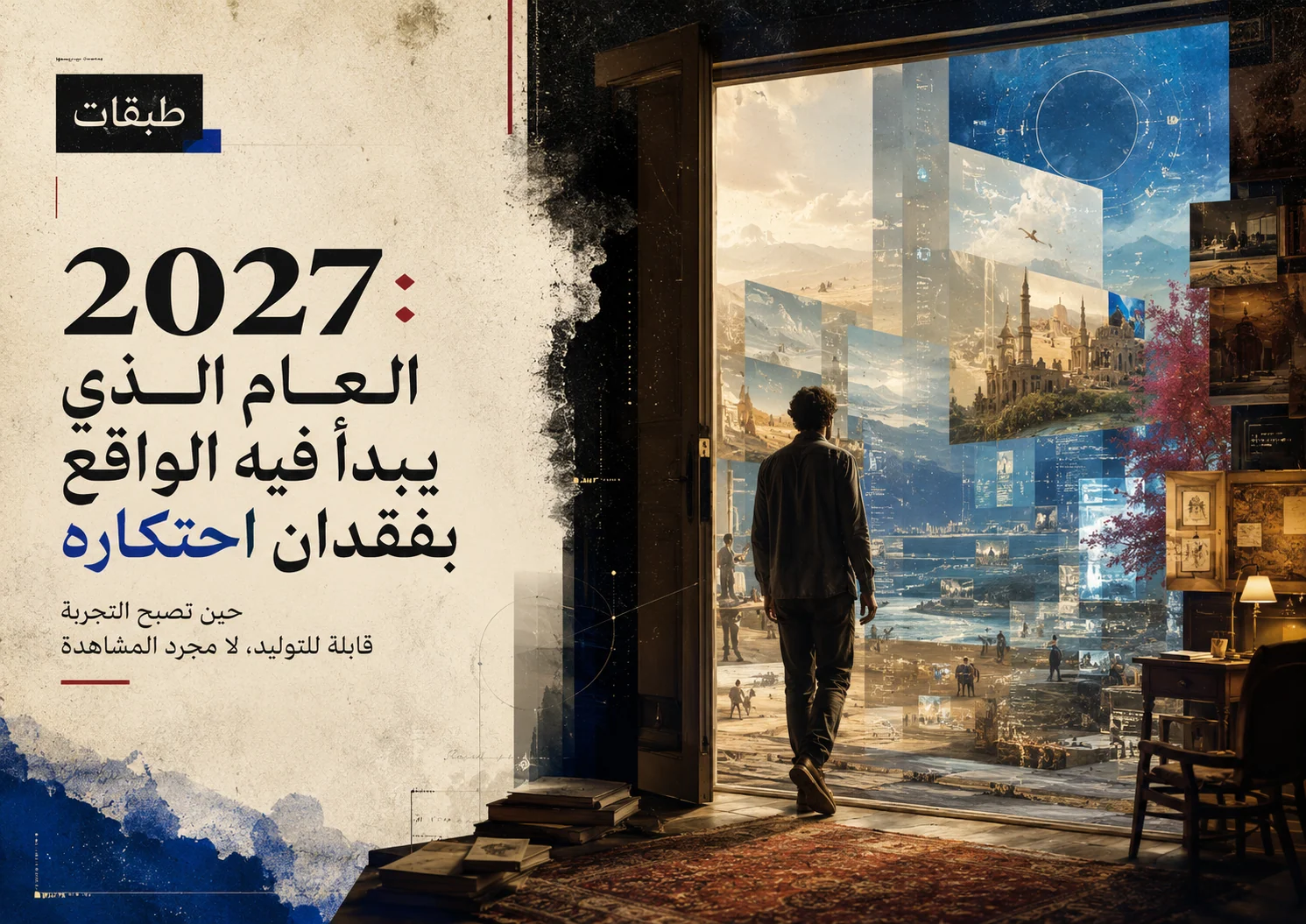
Imagine a student beginning a university programming degree this year. Before graduating, programming as it is taught today may no longer be a profession the market needs.
He will pay the fees, attend lectures, learn Python, JavaScript and data structures, implement projects, and spend four full years to graduate with a degree that says he is a programmer.
But I believe that before he graduates, programming in the form he learns today will no longer be a profession that the market needs.
The problem will not be that a new programming language will replace an old one.
The problem is that the human being himself will not be the one writing most of the code.
He will describe what he wants aloud, discuss it with the system, change his mind, and ask for another version. AI agents will design, program, test, revise, and deploy.
The code may still exist inside systems, just as machine language remains inside computers, but most humans will not need to write it or learn its details.
For me, this is not a distant hypothesis that would take twenty years.
I believe that programming, as a broad profession in which people learn languages in order to write commands line after line, will lose its meaning in about two years.
A small group may remain working on deep architecture, research, or highly sensitive systems. But the idea that millions of students should study programming languages today in preparation for the labor market in four years’ time seems to me similar to teaching them to operate manual telephone exchanges at the beginning of the era of smart phones.
If this is the case with programming, which is one of the professions that we most believed represents the future, then what about the rest of the specializations?
What about accounting? And marketing? And design? And translation? And the media? And analysis? And management? And customer service? And initial legal work? And every job whose owner spends most of his day in front of a screen, reading information, processing it, and then producing other information?
We are not talking about simple development in business tools.
We are talking about the disappearance of the foundation on which modern education was built:
Study a fixed specialty for several years, then practice the same profession for several decades.
This world is ending before us, while schools and universities are still acting as if nothing has happened.
We discuss cheating while the exam itself is falling apart
Most of the educational discussion about artificial intelligence so far revolves around an almost ridiculous question:
How do we prevent students from cheating?
A student can write a complete research paper within minutes, so the university begins searching for programs that detect whether the text was written with artificial intelligence.
But what if the problem is not with the gadget?
What if the research itself, the way we ask it, no longer measures anything important?
If we asked a student to write three thousand words on a known topic, and an intelligent system could write, improve, and document the text within minutes, what value were we measuring in the first place?
Were we measuring thinking? Or the ability to compile and rephrase texts?
If artificial intelligence could:
- Writing the article;
- Solve the issue;
- Presentation design;
- Data analysis;
- Building the application;
- Summary of the book;
- Preparing the plan;
- Video, audio and image production;
Preventing a student from using it does not protect education.
It protects an exam that has lost its meaning.
The real test is no longer: Can you produce the answer?
but rather:
-Do you know what question to ask? -Do you understand what the system produced?
- Can you spot the error?
- Do you distinguish between an answer that seems convincing and an answer that is correct?
- Do you know when to trust the system and when to stop it?
- Can you turn his abilities into a real result of value?
Artificial intelligence did not create the fraud crisis.
He revealed that a large part of education was based on measuring outcomes that are now almost free.
Within days I can complete the work of an entire team
I am not basing this vision solely on articles that predict the future.
I see it in my work.
Today, using templates and agents like Codex and Claude, I can build within days what previously required a team of designers, programmers, project managers, researchers and content creators.
I can start with a vague idea, discuss it in voice, and have the system turn it into an architecture, then an interface, then a database, then a working application.
I don’t need to write every line. I don’t need to know every technique before I start. I don’t need to hire twenty people to do the work of twenty people.
What I can do today does not represent the end of development. This is still his beginning.
If one person can now produce the work of a team within days, what will happen when this becomes ten times easier?
What will happen when a manager is able to talk to his system in a natural voice like he would talk to an employee?
What will happen when he manages not one agent, but dozens of agents working at the same time?
Here the issue is no longer that artificial intelligence “helps the employee.”
The equation becomes:
One person with a good mindset, and a network of agents, versus an entire department of employees.
If a company has twenty employees and one system can cover 90% of their work, why would you keep them all?
You may keep two or three:
- A person who sets goals;
- Someone who reviews quality;
- A person who takes responsibility and deals with people.
As for the rest of the jobs, they will not disappear because they have become completely useless, but because they have become unjustifiably expensive.
The problem is not that some professions will change
The reassuring language we always hear says:
Artificial intelligence will not replace humans, it will replace humans who do not use it.
This phrase may be comforting, but it does not describe what is happening.
If one employee using AI can produce the work of ten employees, the result is not that the ten employees will use AI and become more productive.
The logical result is that the company will need one or two employees instead of ten.
This may not happen immediately in every institution. Some companies may delay due to management, laws, fear, or poor knowledge.
But competition will force it.
If a new company emerges that can offer the same product:
- Twenty times faster;
- Ten times cheaper;
- With greater customization;
- And with a much smaller team;
The traditional company will face two choices: either adopt the same model and reduce the number of its employees, or lose the market.
Competition will accomplish what administrations may hesitate to do.
What does this mean for a student entering university today?
A student entering university in 2026 will likely graduate between 2029 and 2031.
Ask yourself honestly:
Can we predict what business will look like in five years?
We cannot predict the capabilities of models after six months, yet we ask an 18-year-old to choose a major that will define his economic life four years later.
This is not an educational plan.
This is a gamble with four years of a human life.
Take the programming example again.
A student today begins learning to write code manually, while current models have already begun implementing entire projects through dialogue.
When he graduates, the employer may not ask him: What programming languages do you know?
He may ask him:
- What systems can you build?
- What problems can you define?
- How do you manage agents?
- How do you check quality?
- How do you link the product to a real need?
- How do you act when the result is wrong?
In many cases, the employer may not even need to hire him.
Not because the student failed.
Rather, because three people were able to run a company that needed thirty.
The university will collapse when the student loses confidence in the job
The university does not just sell knowledge.
She is selling a promise:
Pay the money. Spend four years. Get the certificate. Your chances of getting a stable job and better income will increase.
As long as this promise remains convincing, students will continue to enroll even if the lectures are weak and the curricula are outdated.
But what happens when a student loses confidence in the result?
What happens when he sees graduates sitting at home, while someone who did not enter university built a project within months using artificial intelligence?
What happens when he realizes that the major he is going to pay money for may lose its value before he gets the degree?
What happens when companies start valuing track record over specialty name?
Not all students will need to refuse university.
Universities, especially medium-sized and fee-based universities, are more fragile than they seem.
Suppose that a university receives five thousand new students every year. If enrollment drops by just 10%, that means five hundred fewer students.
If the annual fees for each student are three thousand dinars, for example, the university loses one and a half million dinars in one payment, and then the loss continues in the following years.
If the decline becomes 20%, the crisis begins quickly:
Decreased enrollment → financial deficit → reduction in programs and professors → decline in quality of experience → decline in reputation → further decline in enrollment.
This is why a university does not need to lose all its students in order to collapse.
It may be enough for one in five students to lose confidence in the value of a degree.
Not all universities are equal
Some universities will stay longer.
Universities that have advanced laboratories, hospitals and clinical training, strong networks, social standing, real experts and researchers, and access to opportunities that the student cannot obtain alone will survive because they do not sell lectures alone.
But a university that sells a traditional class, a recorded lecture, a memorization exam, a general certificate, and a specialization that is not linked to a real result will find itself facing a competitor that does not resemble a university at all.
It may be a six-month educational system that gives the student:
- Personal tutor;
- Real projects;
- Experts when needed;
- Small community;
- Practical training;
- A verifiable record of what he has accomplished; -And the cost is much lower.
Which path will the student choose?
Four years of learning what he might not need? Or months during which he builds clear capabilities and something that can be displayed or sold?
The specialty itself will lose its meaning
We divide knowledge into disciplines because the institution needs to organize students, professors, and materials.
But the real problems do not respect the boundaries of colleges.
If you want to build a system that helps Palestinian farmers improve their production, you need agriculture, data, economics, design, programming, psychology, marketing, legislation, and an understanding of the local community.
In the current university, these fields are divided between colleges and departments that sometimes do not talk to each other.
In the age of artificial intelligence, you can start with the problem, then learn what you need as you build it.
Instead of saying: I specialize in programming.
“I build systems that solve problems in agriculture,” she says.
Instead: I specialize in marketing.
She says: I can launch a product, understand its audience, test its messages, analyze its results, and develop it.
Specialization will not disappear in areas that require very deep knowledge.
But specialization as a fixed, lifelong identity will lose its status.
Humans will become more like a project leader who learns as needed, calls on human and artificial expertise, and connects domains together.
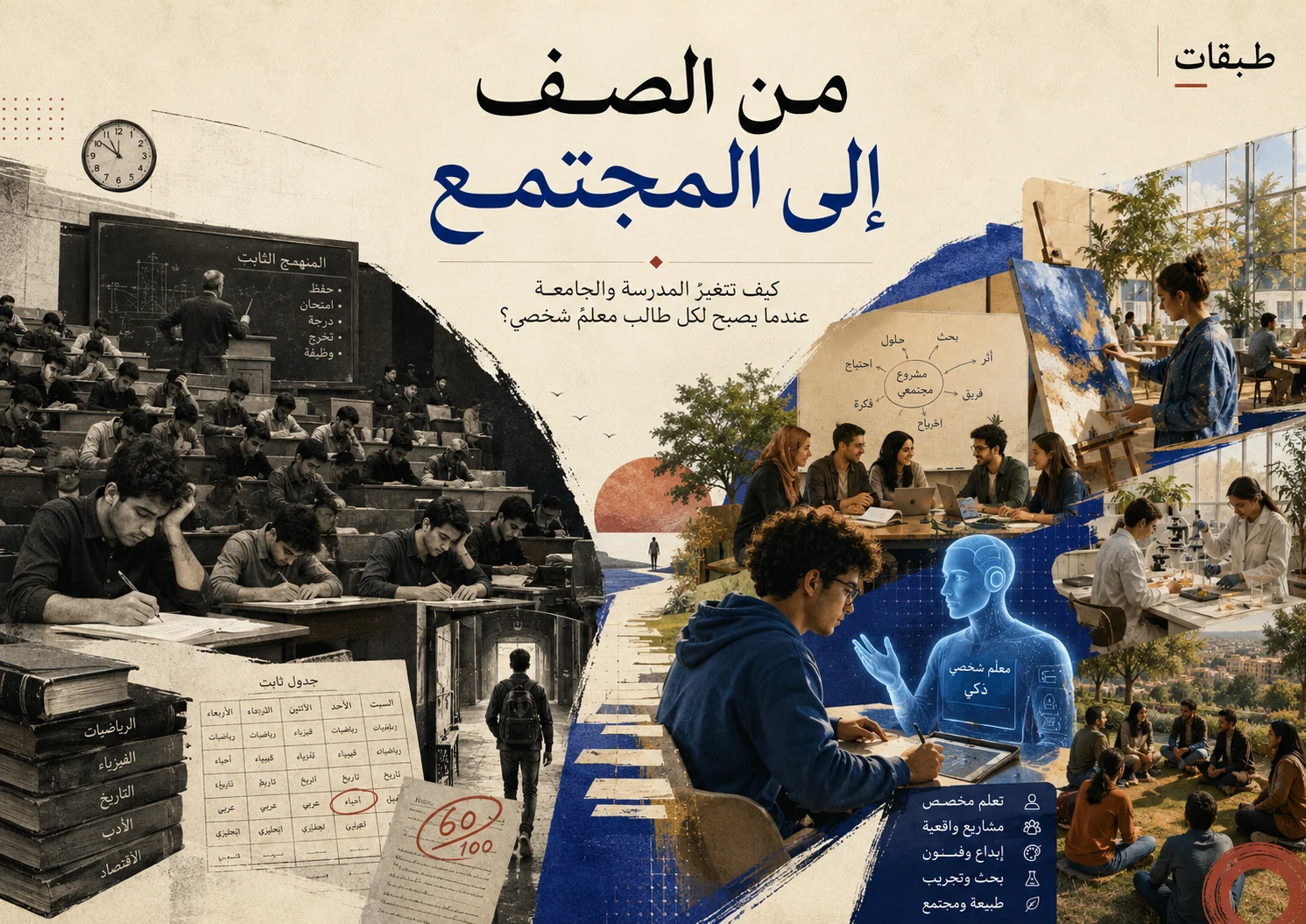
If we designed a university today, would we build it this way?
If the university did not exist, and someone asked us to design an institution to prepare young people for the world of 2030, would we say:
- We gather them in halls;
- We divide knowledge into separate subjects;
- We explain the same content to them at the same speed;
- We test their memory at the end of the semester;
- We give them marks;
- And we wait four years before we ask them to produce something real?
I don’t think so.
The new university must be built around four things.
1. Real problems
The student does not enter the “Business Administration major.”
Takes on a challenge:
- How do we build a company that exports from Palestine?
- How do we reduce water waste?
- How do we redesign health care?
- How do we protect the Palestinian archive?
- How do we build Arabic teaching tools?
- How do we produce media that competes globally?
- How do we reorganize a city, institution, or sector?
While working, he learns what he needs.
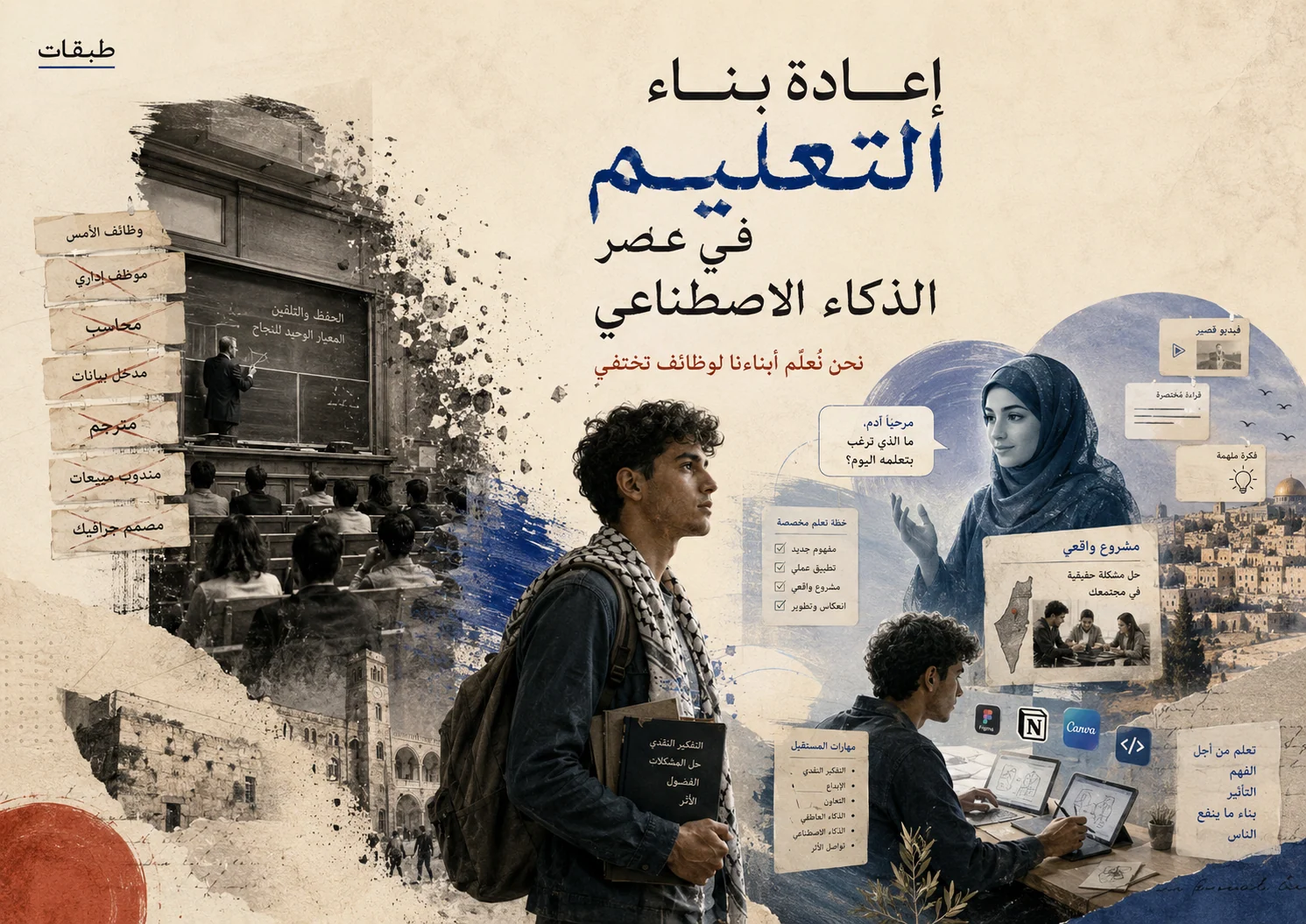
2. Personal AI tutor
Every student has a system that knows his level, what he has forgotten, what he understands wrongly, his method of learning, his goals, his project, and his strengths and weaknesses.
He not only gives him the answer, but tests him, challenges him, asks him to defend his idea, and creates exercises that suit him.
3. Human experts instead of traditional lecturers
The professor does not need to repeat the explanation of basic information every year.
AI handles the initial annotation, training, and iteration.
The professor focuses on judgment, criticism, discussion, experience, ethics, projects, relationships, and questions to which there are no ready answers.
4. An ability record instead of a general certificate
A student does not graduate with a paper saying that he passed forty subjects.
He graduates with a record stating:
- What did he build?
- What problems did he solve?
- What did he fail at?
- How did he change his decisions?
- How to use artificial intelligence;
- What can he do without help? -And how it works with humans.
This is the signal the new world needs.
The school, too, is built on a logic whose time has passed
School may seem safer than university because children will still need a basic education.
But the current school was built on the assumption that the best way to teach thirty children was for one person to stand in front of them and explain the same idea in the same way at the same time.
This assumption was never true.
It was an urgent solution because we cannot provide a private teacher for every child.
In one class, you may find a child who understood the lesson before the explanation finished, a child who needs a visual example, a child who has not understood a basic idea for two weeks, a child who feels bored, a child who is afraid to ask questions, a child who memorizes without understanding, and a child who has stopped following along completely.
However, the whole row moves at the same speed.
When every child has a personal AI teacher, this justification falls away.
A teacher who can talk to him in his voice, know his true level, repeat the explanation without getting bored, turn the idea into a story, game or experiment, change his style according to the child, discover the gap immediately, test understanding instead of memorization, and remember the student’s entire journey.
So why do we keep explaining the same lesson to thirty children as if they were one mind?
The school will not disappear, but it will stop being a lesson factory
I don’t envision a future where children sit alone in front of screens all day.
This is not advanced education.
This is isolation.
A child needs humans. He needs play, movement, friendship, difference, cooperation, losing and winning, art, nature, responsibility, a role model in front of him, and someone who notices that he is sad even if he does not say anything.
But this means that the school must redefine its role.
Instead of the child spending six hours receiving explanations, his day could become, for example:
Three hours for in-person learning
Condensed basic knowledge, tailored to the child:
- Reading;
- Writing;
- mathematics;
- the sciences;
- Languages;
- Logical thinking.
The rest of the day is for life
- Sports;
- Theater;
- Music;
- Agriculture;
- Group projects;
- Trips;
- Laboratory;
- Manual labor;
- Community service;
- Conflict resolution;
- Dialogue;
- Build real things.
Here the school turns into a social, humanitarian and creative center.
The child does not go to it because the information is there.
He goes there because people are there.
The teacher will not disappear, but his current profession will disappear
As programming will change radically, the teacher’s profession in its current form will not remain.
It would not be of primary value for a teacher to explain a grammar rule or equation in the same way every year.
The system can do this, and it may become better at customization, patience, and follow-up.
The human value of the teacher will become:
- Seeing the child;
- Understand his condition;
- Building his confidence;
- Group leadership;
- Relationship management;
- Notice the danger;
- Design of experiments;
- Teaching responsibility;
- Protecting intellectual independence;
- And give the child a feeling that he is known, and not just a number within the system.
The future teacher is more of an educator, mentor, coach, and small community leader.
We may need fewer people teaching lessons.
But we will need better humans at building humanity.
The real danger: that the student will become helpless without the machine
Artificial intelligence may free education from memorization and repetition.
But it may also produce a generation that can produce everything and cannot think alone.
A student writes an essay that he cannot explain. Builds an application that doesn’t understand how it works. Solves a problem without knowing where the answer came from. He designs a project whose success and failure he cannot distinguish.
This is not a simple possibility.
It is one of the biggest dangers of the next stage.
Therefore, it is not enough to put an artificial intelligence teacher in front of the child and consider that the problem has been solved.
We need two types of evaluation.
What can the student do alone?
-Does he read and understand? -Can he think patiently? -Does he remember the basics? -Does he explain his logic? -Is he dealing with a new issue?
What can he do with artificial intelligence?
-Does it give him the right target? -Does he review it? -Does he detect the error? -Does it connect more than one tool? -Does it produce a valuable result? -Does he bear responsibility for the decision?
We need the independent person.
We need the human multiplied by the machine.
As for the person who cannot work unless the system tells him every step, he will be a follower, no matter how beautiful his outcomes are.
Palestine does not have the luxury of waiting
In Palestine, we do not discuss education within a huge economy that can absorb failed experiments for years.
We have:
- Small and restricted labor market;
- Large numbers of graduates;
- Universities that rely heavily on fees;
- Specializations that do not lead to clear opportunities;
- High unemployment among young people and graduates;
- Frequent interruptions in education;
- A gap between the university and the labor market;
- And widespread reliance on the traditional job model.
Now artificial intelligence is coming to put pressure specifically on the jobs that graduates were waiting for: management, accounting, programming, media, marketing, translation, design, and office work.
If our universities continue to graduate the same numbers with the same majors, we are not preserving education.
We are increasing the number of young people who will give up years of their lives to prepare for jobs that are shrinking or disappearing.
The result may be more serious than unemployment.
An entire generation may feel that they did everything society asked of them: they studied, succeeded, entered university, obtained a degree, and then discovered that the deal had changed after they had paid the price.
This generates anger and loss of confidence in institutions, not just an employment crisis.
What could a Palestinian university do differently?
Imagine a Palestinian university that does not measure its success by the number of certificates it issues, but by the number of problems it helps solve.
Since their first year, each student has been working on a real project:
- Clinic system;
- A platform for agricultural products;
- Educational tool;
- A project to preserve heritage;
- Municipal management system;
- Exportable digital product;
- International media campaign;
- A solution to an energy or water problem;
- Service for a small enterprise.
A student does not wait four years until he is “ready.”
Production starts from the beginning.
He learns from the project, draws on AI and experts, and discovers what he’s missing while working.
At the end of the path, he graduates with projects, relationships, a record of decisions, experience with real organizations, the ability to work with artificial intelligence, and perhaps a company or product of his own.
This university does not prepare a student to wait for a job.
You equip him to create value even when the job isn’t there.
What if we redesigned the Tawjihi?
Does it make sense for a few weeks of exams to determine a student’s future after twelve years of education?
Do we measure understanding? Or memorization? Or the family’s ability to provide private lessons? Or the student’s ability to withstand pressure?
In the new system, student evaluation can consist of:
- Common basic knowledge;
- Long project;
- Oral presentation;
- Business file;
- Community service;
- Ability to research and verify;
- Testing without artificial intelligence;
- And test using it.
We don’t need to abolish the national standard.
But we need to stop reducing humanity to one sign.
What if we built a Palestinian teacher for every child?
It is not a general application that only translates foreign content.
Rather, it is a system:
- Knows the Palestinian curricula;
- He speaks Arabic fluently;
- Understands context and dialect;
- Works with weak internet;
- Allows downloading lessons;
- Saves student progress;
- Helps a child who is out of school;
- Supports the teacher instead of monitoring him;
- It protects children’s data.
A student in a village, camp, or isolated area can get a personal tutor of no less quality than a student in an expensive school.
This is not just an educational opportunity.
It is an opportunity to reduce some of the inequality that has always been inherent in education.
But the most dangerous question is:
Who will own this teacher?
If our children’s data, their content, the way they are evaluated, and everything the system knows about their weaknesses resides entirely with outside companies, then we do not own our education system.
We rent it.
Therefore, redesigning education must also be a project of Palestinian and Arab knowledge sovereignty.
Scenario 2028
Let’s imagine that we have reached the year 2028, less than two years away.
Manual programming has become a specialized and rare activity.
- Small companies operate agents instead of entire departments. Building a website or application has become closer to managing a dialogue than a software project.
- The artificial teacher speaks to the child naturally, in audio and video.
- He can analyze his level and build a special curriculum for him. Companies began testing people by what they can produce, not by their certificates.
- Employment in entry-level jobs has decreased. Students began to hesitate to enter expensive specializations with an unclear future.
In this world, what is the value of a university that still tells the student:
Attend the lectures, memorize the materials, finish the hours, and then we will give you a paper after four years?
What is the value of a school that still gathers thirty children to explain the same page to them at the same speed?
Scenario 2030
A child who enters first grade today will remain in school education until the late 2030s.
Think about the size of the mess:
We don’t know what business will look like in two years.
Yet we act as if we know what a child must learn in twelve years.
He may reach university age in a world:
- The job is not the primary form of work;
- Where specialization is not the economic identity;
- Writing, design, and programming are not rare production skills;
- In which one individual can build an entire institution;
- The value becomes in ownership, governance, relationships, and goals, not in carrying out tasks.
However, we still fill his day with memorization and exam preparation.
This is not conservatism about education.
It is training a generation for a world that will never exist.
Fear is not the problem
Whenever someone speaks clearly about these transformations, someone appears who says:
We should not spread fear.
But what if the fear was logical?
What if reassuring language is the danger?
If a building is on fire, it is not our responsibility to tell people that there is a slight possibility of overheating.
Responsibility is to say that the building is burning.
I don’t think universities will change quietly in twenty years.
I do not think that programming will remain a popular profession and then develop a little.
I do not think that the school will be able to maintain the traditional classroom after each child has a personal teacher who excels in explanation and personalization.
I think we are facing a real disconnect.
The financial collapse of some institutions may begin before they even understand what is happening.
What should we teach then?
If rare knowledge, stable employment, and fixed specialization are no longer the foundation of the world, then education must build the human being around what remains important:
- The ability to think without assistance;
- The ability to use intelligence that surpasses his in many areas;
- Judgment;
- Values;
- Responsibility;
- Understanding humans;
- Building relationships;
- Selection of problems;
- Meaning making;
- The audacity to start;
- Ability to learn quickly;
- Owning something instead of just carrying out other people’s orders;
- And knowing when to tell the system: You are wrong.
The future will not necessarily reward the person who knows more information.
The machine will know better.
Whoever writes the code the fastest will not be rewarded.
The machine will write faster.
Those who produce a greater number of designs and reports will not be rewarded.
The machine will produce more.
The value will be transferred to the person who knows:
-What does he want to build? -And why? -And for whom? -And what shouldn’t he do even if it were possible?
We don’t have ten years
I am not calling for schools and universities to be closed tomorrow.
But I reject the idea that we have too much time for lazy committees, studies, and plans.
Today’s college student may enter an institution that loses most of its economic value before he finishes his second year.
A child may spend twelve years preparing for jobs that he will only see in history books.
The danger is not that we move too quickly.
The danger is that we try to protect the old institution until the generation within it becomes the price.
We now need real experiments:
- A school whose day is completely redesigned;
- A university that replaces discrete subjects with problems and projects;
- A personal AI tutor for each student;
- Capacity-based assessment;
- Short tracks instead of long certificates;
- Institutions that allow the student to build from day one;
- And a Palestinian structure whose data and content we own.
We don’t need to add a class on artificial intelligence to the schedule.
We need to rebuild the table itself.
We do not need to teach the student how to use a new tool.
We need to rethink why school and university exist at all.
The question is no longer:
How do we introduce artificial intelligence into education?
The real question is:
If we were designing the school and university today from scratch, in a world where artificial intelligence can explain, write, program, design, analyze and implement, would we build them as we know them?
I think the answer is clear.
I believe that the time available to us is much shorter than we want to admit.
Carry the question forward
If we were designing schools and universities from scratch today, would we build them as we know them?
The discussion below is designed for considered responses. Name the evidence or lived context your answer depends on.