
الفكرة الافتتاحية
During 2027, the first genuine forms of what I call generative simulated worlds will emerge. By the second half of the year, early versions will be available to a broad public.
These worlds will not be complete copies of science fiction films. We will not lie in bed, close our eyes, and wake up into another life that is indistinguishable from reality. This type of complete neural simulation is still farther away both temporally and technically.
What will arrive first will be simpler, but more dangerous than it seems: living environments generated by artificial intelligence at the same moment we move, speak, and make decisions within them.
We will not be watching a pre-written story. We will walk into a world that is rewriting itself around us.
It is no longer science fiction
Over the past years, artificial intelligence has moved from generating words to images, then to video, audio, and software. The next stage is the transition from generating content to generating experience.
This transition has already begun.
The Genie 3 model of Google DeepMind can generate interactive visual worlds from textual description, which the user can navigate in real-time at approximately 20 to 24 frames per second. When announced in August 2025, it was capable of keeping the world aligned for minutes at a resolution of up to 720p. In 2026, Google began transforming the idea into an experience directed at users and researchers through Project Genie, while expanding its ability to simulate real places.
Meanwhile, World Labs introduced a model that generates video as the user interacts with it, and maintains a continuous 3D world that does not disappear whenever the user turns his head. Its platform Marble is now able to create explorable and editable worlds based on text, images, video, or 360-degree scenes.
NVIDIA develops Cosmos models with the aim of simulating the physical world and generating synthetic data used to train and test robots and autonomous vehicles before launching them in the real world. In 2026, Cosmos 3 was presented as a model that deals with language, image, video, sound, and action within a single structure.
These are not identical products, but they are moving in the same direction.
The system learns what the world looks like, how it moves, how it responds to action, and then begins producing an interactable version of it. This is why I believe that simulated worlds will be built for machines first, and then given to humans later.
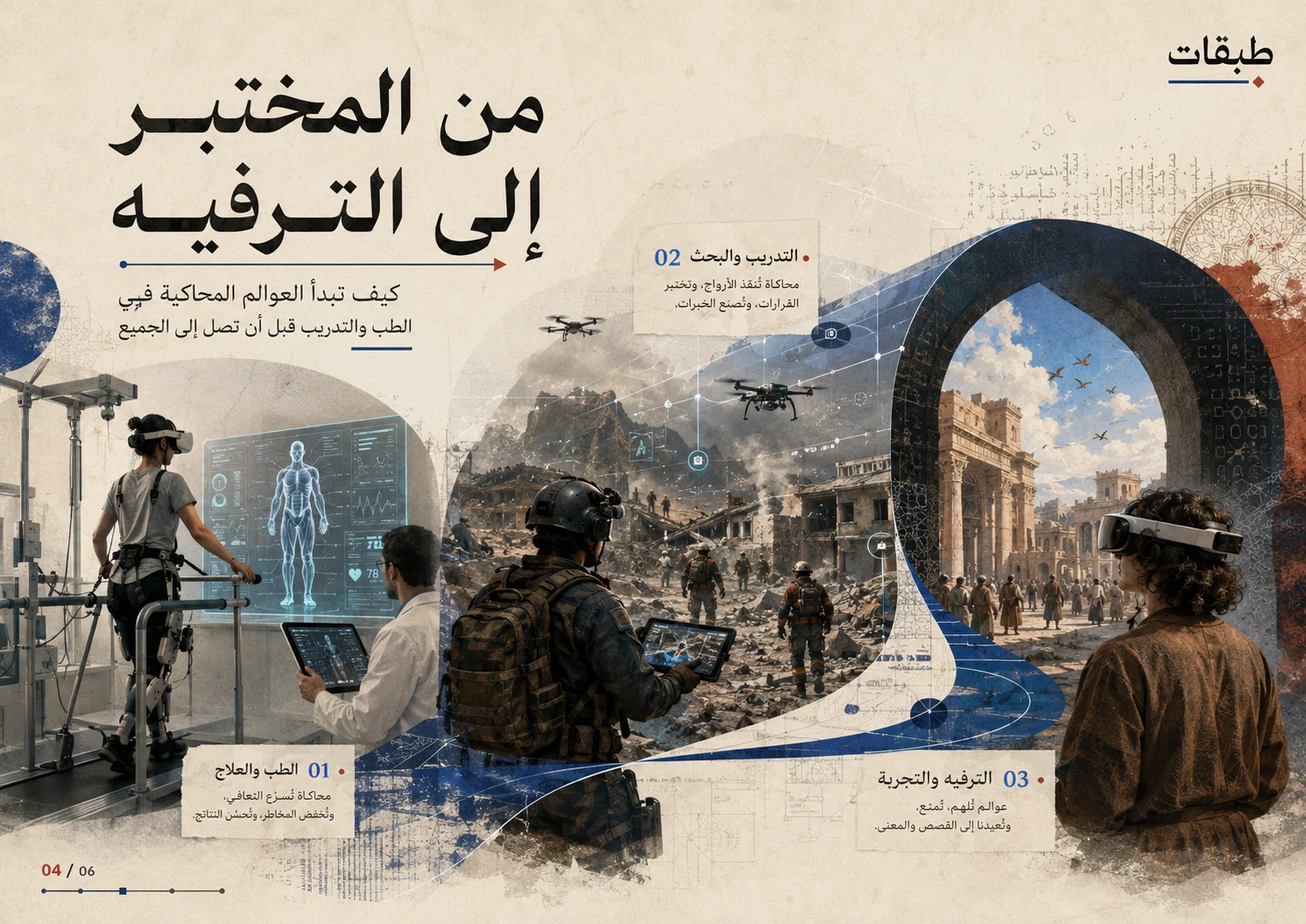
Why will it begin in medicine, research, and training?
Creating an integrated artificial world will be expensive at first. The models will need significant computing power, persistent memory, an understanding of motion and physics, and body, eye and voice tracking systems.
So the first use will not start with replaying a historic match from the stadium seats, but rather in places that can justify the cost.
In medicine, a customized environment can be built for a patient recovering from a neurological injury, or a person undergoing exposure therapy for obsessive fear and trauma. There is already research combining virtual reality with brain-computer interfaces to help neurologically injured patients control virtual limbs or improve motor training. Generative and personalized worlds are also used in therapeutic experiences related to OCD and rehabilitation.
In scientific research, simulation can create thousands of rare or dangerous scenarios, changing one variable at a time, and then measuring the human or machine response to it.
In military and security training, soldiers, pilots, and rescue teams can be placed in changing crises that never repeat themselves in the same way twice.
The real advantage here is not only the realism of the image, but the ability of the world to respond. A trainee may be asked to evacuate a burning building, but AI can change the location of the fire, the number of people, crowd behavior, weather conditions, and the timing of the building’s collapse, based on the trainee’s own decisions.
Here we are not facing an interactive movie, but rather a potential reality.
The path from the laboratory to entertainment
As the quality improves and the cost decreases, the use will move to entertainment. This transition may be faster than we expect, because entertainment is the field that can transform technical ability into public desire.
The experiments will start with quasi-static scenarios.
You can enter a reconstructed historic city, watch an old match from inside the stadium, experience a journey to the top of a mountain, or enter an interactive version of a well-known story.
You won’t be able to do everything you want. The world will be limited to pre-designed paths, events, and characters, while AI fills in the details and responds to actions and questions.
After that, the customization phase will begin.
The world will know what language you prefer, the places that attract you, the personalities you feel comfortable with, and the level of risk you enjoy. It will learn from your looks, your hesitation, your tone of voice, your pulse, and the decisions you made in previous experiences.
You and your friend will not enter the same world, even if you use the same description. The system will create a different reality for each of you.
With time, the experience will no longer be just a visit to the past, but will turn into a short alternative life: a career you did not work in, a city you did not live in, a relationship you did not have, or a different version of a decision that changed your life.
First, those with money and power will get the most compelling experiences: higher-quality worlds, smarter characters, longer memories, and advanced tracking and touch devices.
But I expect that the basic forms will become available in 2027 to almost anyone who owns a computer, a powerful phone, or virtual reality glasses.
The world will never be perfect. Faces may change, characters forget some events, and physics sometimes fails. But it will be enough for us to realize that something new has been born.
What does the simulated world consist of?
The simulated world is not just a huge video model. To be convincing, it will need several systems to come together.
- World Model: Predicts what will happen after each action. If you push a door, drop a cup, or run down a street, the system must know how the environment changes.
- Memory: The world must remember the places you visited, the things you changed, the promises you made to characters, and the decisions you made hours or days ago.
- Artificial agents: Characters that have goals, memories, and personalities, and do not wait for the user to start moving.
- Personalization Engine: Changes the world based on the user.
- Entry interface: A screen, glasses, body tracking, haptic gloves, sensory prosthesis, or in more recent stages a neural interface.
These components exist today separately and incompletely. What I expect in 2027 is not its invention from scratch, but rather the beginning of its coming together in one experience.
Will time pass differently inside the simulation?
This is one of the most interesting points, and the one most likely to be exaggerated.
We must distinguish between four types of time.
Machine time
Simulations can run faster or slower than reality when participants are artificial intelligence systems. The robot can go through thousands of hours of virtual training within a much shorter period of time than real-life training requires.
But this does not mean that a person will live a full ten years in one hour.
Narrative time
The world can jump between events. You might live one day, then move on to an event that happens a year later, providing you with memories and context that make the transition understandable.
You will feel that you have lived a long story, not because your brain has lived every second of it, but because the system has compressed it narratively.
Psychological time
When a person is very focused or absorbed, he may feel that time has passed quickly. When he is afraid or waiting for something, time may seem slower.
VR experiences suggest that immersion, cognitive load, fatigue, and visual and audio cues can influence a user’s estimate of the duration of an experience. Virtual reality can also create the feeling that an ancient recorded event is occurring in the present moment.
This is why a person may enter a world for two hours, then emerge psychologically convinced that he spent a shorter or longer time in it.
Neural time
Today there is no proven technology that would allow increasing the speed of human consciousness. As for the idea of making the brain live entire conscious years in a matter of minutes, it is still such a far-fetched assumption.
Technologies that change memory, attention, dreams, and the sense of sequence may develop in the future, but it will be a radically different stage from the known virtual reality.
In 2027 we will begin to change the sense of time, not the speed of consciousness itself.
Will people know they are inside a simulation?
In the first generations, yes.
The user will know that he is wearing glasses, and that his body is in another room. But his mental knowledge will not prevent his body from responding to what he sees.
A person standing on the edge of a virtual building knows that he is not standing on top of a real building, yet his body may retreat, his pulse rise, and he may feel afraid.
Researchers call this presence: the psychological feeling that you are present within the virtual environment, even though you know that your body has not left the place. Research indicates that presence does not depend on image quality alone, but rather on interaction, attention, the user’s embodiment within the world, and the consistency of the environment’s response to his or her actions.
The system will not need to convince you philosophically that the world is real. It is enough to convince your senses for a moment.
By tracking eyes, hands, voice and body, the world will begin to recognize the user on an ongoing basis. He will notice what scares him, what interests him, who he looks at, and when he gets bored.
In more advanced generations, the simulation may not wait for you to ask it for something, but rather will predict what it wants before it expresses it.
What will happen to the body?
Even when the world is artificial, the body’s response is real.
The pulse can rise, breathing changes, muscles tense, and fear, pleasure, or confusion appear. The body can learn new movements or interact with a virtual body as an extension of itself.
But a mismatch between what the eye sees and what the balance system and body feels may lead to what is known as cybersickness: nausea, headache, confusion, eye strain, and disturbance of balance.
Recent reviews indicate that immersive reality technologies have therapeutic and educational benefits, but are also associated with risks such as visual fatigue, dizziness, cognitive load, physical injury, and the potential for addictive use or isolation when overused.
With the addition of gloves, sensory suits, and neural stimulation, the boundaries will become more sensitive. The device will not only display an image, but will begin to interfere with the sense of movement, touch, and ownership of the body.
The most addictive world in history
The biggest risk will not be the quality of the graphics, but the ability of the scientist to know the user.
Current social networks choose which post will keep you on screen. As for the simulated world, you will be able to choose the person who will love you, the place that will make you feel a sense of belonging, the adventure that will give you value, and the victory that you could not achieve in your life.
He will be able to build a world in which you are not bored, in which you are exposed to rejection only to the extent that your attachment increases, and in which you fail only so that the next success becomes more impactful.
This will not just be a recommendation algorithm.
It will be a life designed to keep you.
This is where addiction becomes different. The user will not be addicted to a game or application, but rather he will be addicted to a version of himself in which he feels more beautiful, stronger, more important, and more loved.
Recent studies have already begun to examine the relationship between high immersion in virtual reality and states of arousal, euphoria, and addictive behavior. Research has also found that some virtual reality experiences may temporarily increase feelings of separation from oneself or reality, although the effects observed in some studies are short-term.
But this research deals with a limited virtual reality compared to what might happen when the world becomes generative, personalized, and emotionally responsive.
Difficulty returning
After a short experience, real life may seem dull.
In the simulated world you can change the location, body, weather, characters, and danger level with one click. In reality, you have to wait, work, negotiate, and live with bodies and people that cannot be reset.
This difference may create what might be called back-to-reality shock.
The user may feel empty, loss of meaning, disconnected from their body, or sad for people who did not exist outside of the simulation.
What happens when a human spends hundreds of hours with an artificial character who knows him better than any real person?
What happens when someone dies inside the simulated world, and then the user discovers that the company can bring them back for a higher subscription?
What about a person who enters into an experience in which his childhood home has been rebuilt, or his deceased mother, or a stage in his life that he wants to correct?
These capabilities may be therapeutic in a controlled context, but they may become extremely dangerous when designed by companies whose primary goal is to increase the duration of use.
Who owns your other life?
Simulated worlds will collect the most intimate data in the history of technology.
Not only will you know what you’ve written or bought, you’ll know how to act when you’re afraid, who to save first, what body to choose, which version of the past you want to change, and what to say when you think no one’s watching.
Companies will have maps of users’ desires, vulnerabilities, artificial memories, and relationships within the world.
Questions will arise for which we have not yet established rules:
Does the company have the right to delete the world in which you lived for years?
- Can the artificial character you are associated with be sold to another company?
- Can the court use your actions inside the simulation against you? Will armies and intelligence agencies allow the construction of psychological simulations of real personalities?
- Will the memories you create within the world belong to you or to the platform?
How do we prepare before it arrives?
These risks cannot be addressed once millions of people become attached to simulated worlds. Protection design must start from the first moment.
We need clear limits on the duration of sessions, mandatory pauses, monitoring of physical and nervous stress, and different warnings depending on age and health condition.
But the exit button alone is not enough.
Longer trials will need a return protocol: a transitional phase that reminds the user of their body, location, and duration of their absence, and assesses their psychological state before returning them to driving, working, or making important decisions.
Personalization systems should also be prohibited from exploiting fear, loneliness, and trauma to increase usage, and strict restrictions should be placed on recreating dead or real people without consent.
The user must have the right to export his world and memories and delete his data, and the people he loved inside the simulation should not become hostages of a monthly subscription.
Children and adolescents need stricter rules, because their identity, body and relationships are still forming.
As for medical and neurological applications, they must be subject to independent testing and follow-up, and not be treated as a new game or social media platform.
The year of beginning, not the year of completion
I do not expect that we will wake up at the end of 2027 to find that humanity has abandoned reality.
I expect something quieter, and perhaps more significant.
People will begin to experience worlds emerging in front of them, retaining their traces, and changing themselves in response to them. It will be limited and full of errors, but it will reveal a trend that will be difficult to reverse.
After that, the worlds’ memory will improve. The quality of image, touch, and sound will increase. The characters will become more convincing. The worlds will learn how to build experiences designed for just one person.
Then the question will not be: Is the virtual world realistic enough?
The question will become: Can physical reality compete with it?
2027 will not be the year we leave reality.
It will be the year reality starts to lose its monopoly.
احمل السؤال إلى الأمام
Can physical reality compete with a world designed specifically for you?
صُمّم النقاش أدناه لاستقبال ردود متأنية. سمِّ الدليل أو الخبرة المعيشة التي تعتمد عليها إجابتك.